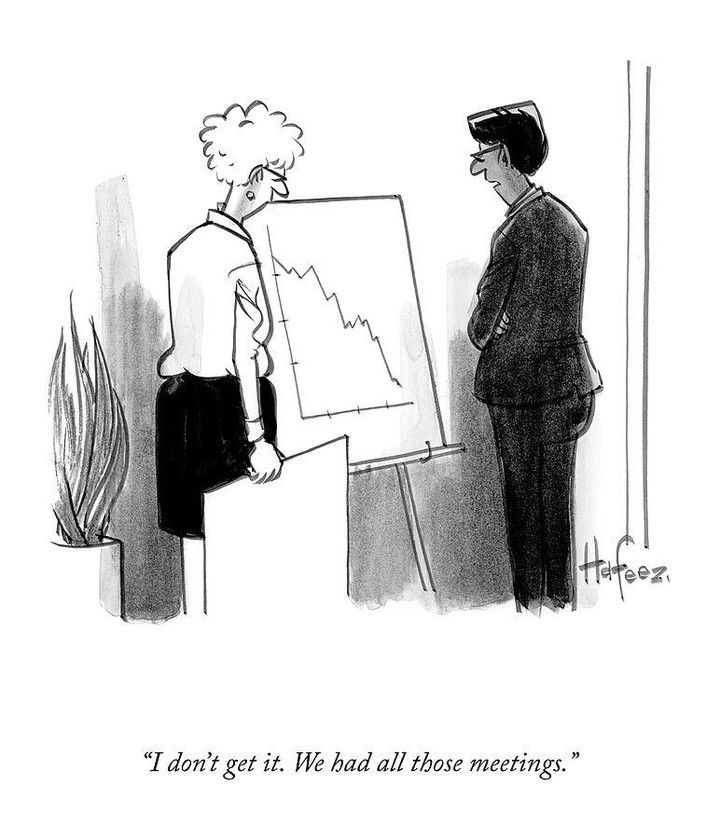
Daily standups are often harmful
- 9:30 “Let’s wait a few minutes for the Business Analysts/Cillian/Jo to join”
- 9:32: “What did you get up to on the weekend?”
- 9:35 “Wait so what’s the status on ticket abc123? How long until it’s done?”
- 9:40 “What’s the status on ticket abc124? How long until it’s done?”
- 9:50 “What’s the status on ticket abc125? How long until it’s done?”
- abc126, abc127, …
- 10:20 “Our burndown is not looking good”
- …
Why do we have daily standups? Often it is said that we do daily standups because of the scrum guide scripture. Of course we shouldn’t do things based on scripture or because its what “we have always done”. Nevertheless, let’s analyse standups on their merits.
Always consider if something is bad because it is in its essence to be bad or just because it has been implemented poorly? Also, does that distinction matter? True communism has never been tried.
It seems that every standup meeting devolves into endless pontification and discussion of details irrelevant to most people present. Endless status updates that do not require the presence of every single person there.
This is not what standups are meant to be. If you are doing scrum (unlikely) or claiming to be doing scrum (probably) then you do daily standups because of the scrum guide. Consider this excerpt
Daily Scrums improve communications, identify impediments, promote quick decision-making, and consequently eliminate the need for other meetings.
Most standups do not follow the scrum guide prescription. Most of the time standups are 90% status updates and 10% banter. In some sense daily standups remind me of the “law of flat surfaces” of interior design.
any flat surface within a home or office tends to accumulate clutter.
I think of standups as conversational flat surfaces. It is in most people’s nature to love status updates and discussing their days. They love meandering around points and never getting to the heart of the matter.
What if we strip away these bad implementations and look at the “ideal” standup does it hold up?
If an impediment is recognised then it should be signalled straight away rather than waiting 24 hours for the standup to bring it up. If a decision needs to be made then message the people you need. If they don’t respond quick enough just call them. A special time in the day for such activities discourages immediate action and promotes idleness.
Standups are sometimes helpful
I believe most of the value of daily standups is in the social cohesion aspect. People want to feel connected, hear each others voices, and feel like they are part of the same team. In this work-from-home era it can feel lonely and humans crave connection.
Additionally, some people find it awkward to reach out for help proactively and prefer to wait for an agreed-upon time in the day to bring up their woes and concerns. This is not ideal but sometimes can’t be helped, especially with more junior team members, as they lack the confidence to reach out first.
If you have to do them
This will always be difficult since you are fighting human nature. Any guidelines you come up with to keep standups on track will, over time, erode away as they become more and more lax.
It should never be the responsibility of a single person to keep a standup on track. This makes it seem like everyone else can do what they want while relying on the “teacher” to keep things in check. Talk with your team about what you are trying to get out of standups and keep it on track together!
Have the courage to tell people to silence themselves. Some people don’t know they talk too much about things that are not relevant to 99-100% of the people present. You think you are being nice by letting them speak but you are doing yourself, them, and the entire team a great disservice by letting them meander.
What else do I do?
I am not 100% sure and am still experimenting with different methods. Here are some proposals.
- For status updates, send daily messages in a slack/teams channel where anyone can take a look if they care.
- For blockers, message or call people straight away. There is no need to wait until the standup to discuss these.